 +91 7483031199
- 0820-2589182
- info@sode-edu.in
- CET CODE-E206
- Career Opportunities
 +91 7483031199
 0820-2589182
 info@sode-edu.in

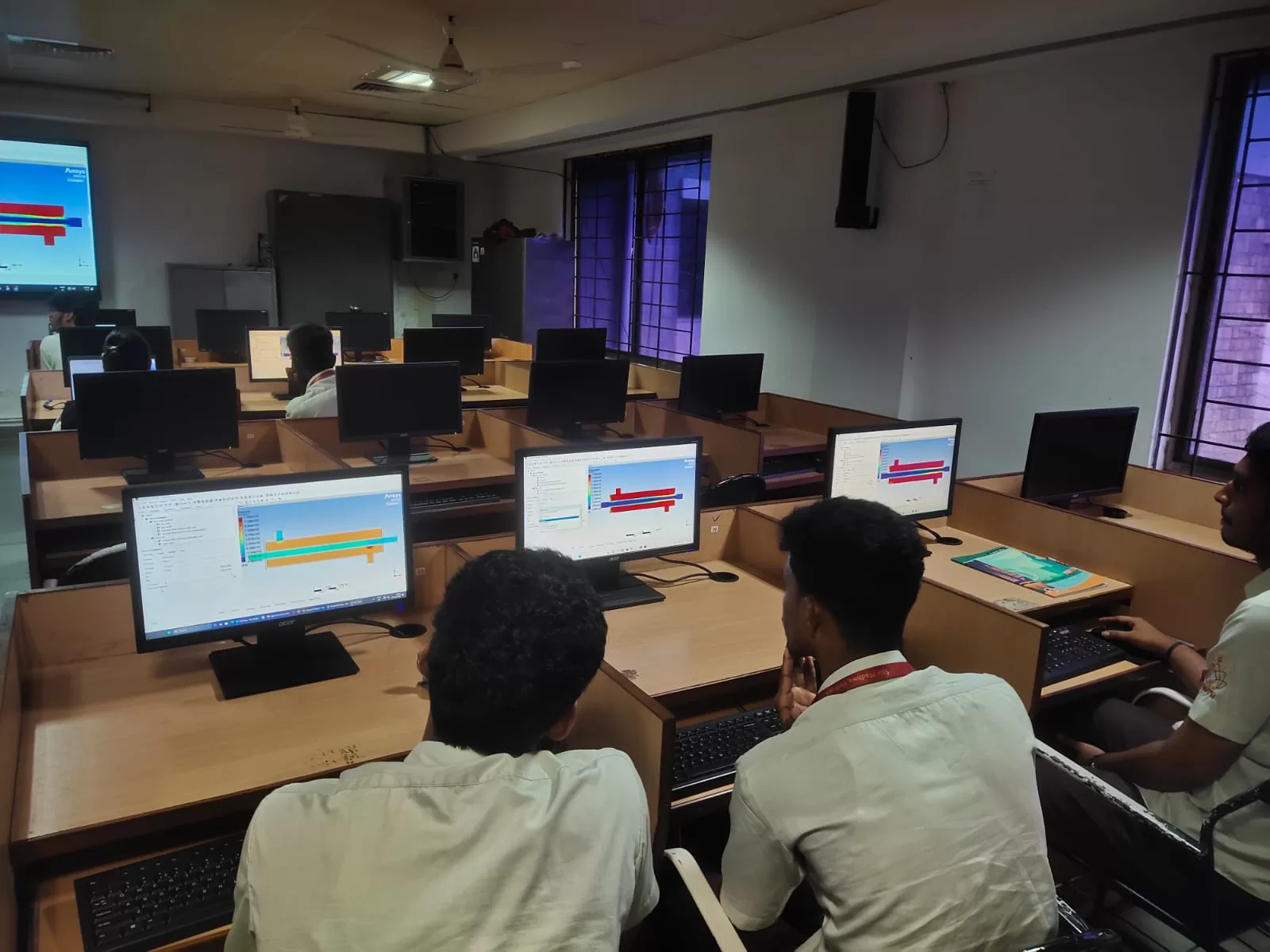 The Department of Mechanical Engineering, in association with the ISTE Student Chapter and Institution’s Innovation Council (IIC), successfully organized a Value Added Program on “Flow Analysis using ANSYS Fluent” from 26 February 2026 to 14 May 2026 for the benefit of second and third-year Mechanical Engineering students.
The program was conducted every Thursday from 9:00 AM to 11:00 AM at the CAED Laboratory and witnessed the participation of 60 students. The sessions were handled by Dr. Manjunatha S, Assistant Professor (Selection Grade), Department of Mechanical Engineering, SMVITM, Bantakal, who served as the resource person for the program.
The objective of the program was to introduce students to the fundamentals of Computational Fluid Dynamics (CFD) and provide hands-on training in the use of ANSYS Fluent for engineering flow analysis. The sessions covered key topics such as fluid flow fundamentals, governing equations, meshing techniques, boundary condition specification, solver settings, turbulence modelling, heat transfer analysis, and post-processing of simulation results.
A major highlight of the program was its practical approach, where students gained experience in creating geometries, generating meshes, performing simulations, and interpreting flow analysis results. Various case studies and industrial applications were also discussed to demonstrate the significance of CFD in engineering design, optimization, and performance evaluation.
The resource person emphasized industry-standard simulation practices, result validation techniques, and troubleshooting methods commonly employed in CFD analysis. Interactive discussions and hands-on exercises enabled participants to strengthen their understanding of simulation-driven engineering and develop confidence in using ANSYS Fluent for solving real-world engineering problems.
The program successfully bridged the gap between theoretical concepts and practical engineering applications. Participants acquired valuable skills in CFD modelling and analysis, which will support their academic projects, research activities, higher studies, and future professional careers in the field of simulation and design engineering.