 +91 7483031199
- 0820-2589182
- info@sode-edu.in
- CET CODE-E206
- Career Opportunities
 +91 7483031199
 0820-2589182
 info@sode-edu.in

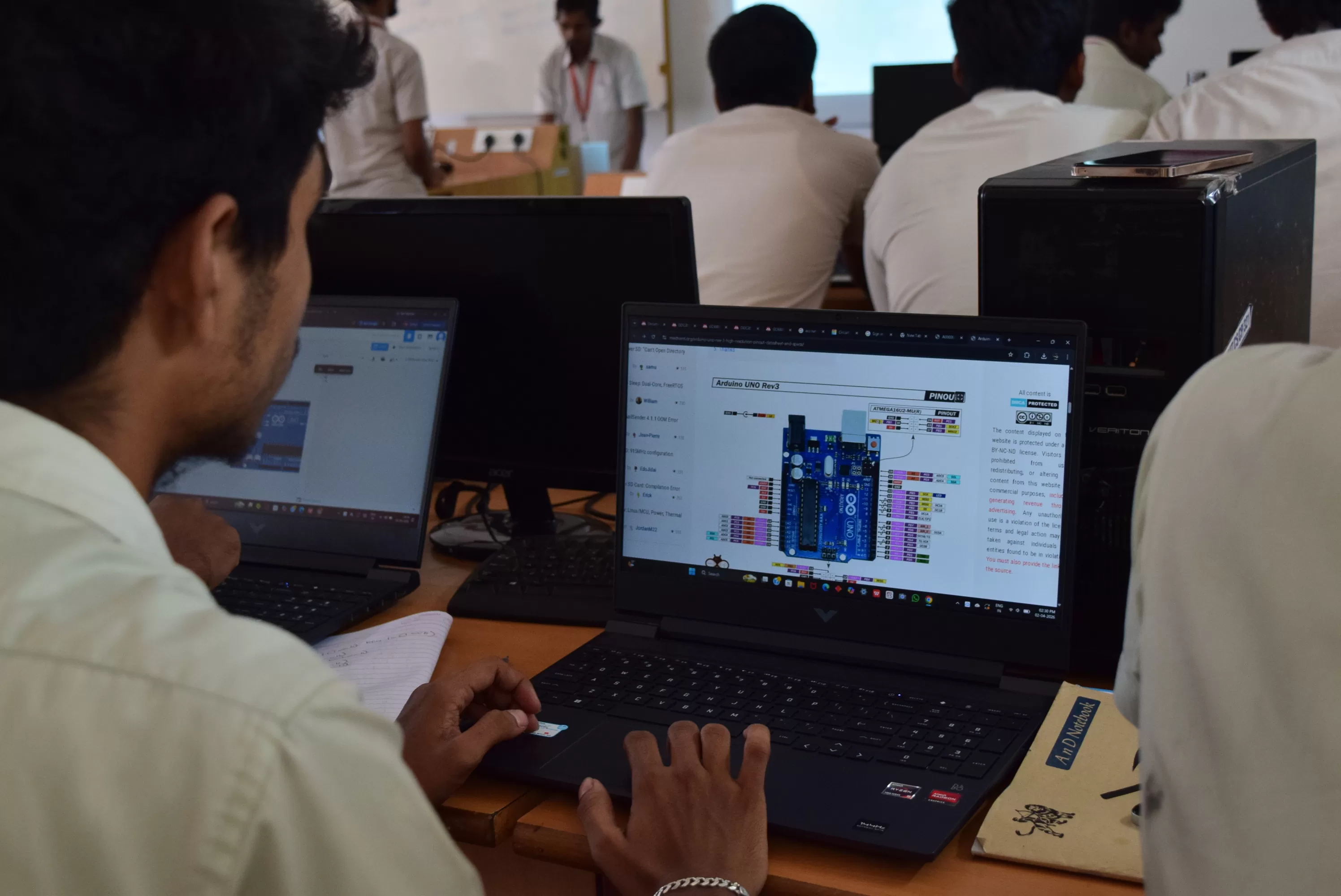 The Department of Electronics and Communication Engineering at Shri Madhwa Vadiraja Institute of Technology and Management (SMVITM), Bantakal, in association with the Technocrators Club, successfully organized a Peer Learning Session on “Introduction to Embedded C” on 2nd April 2026 at the EC Department Lab (B102).
The session was conducted by Mr. Shashank S, a third-year ECE student, for second- and third-year ECE students, with a total of 30 participants. The program aimed to introduce students to Embedded C programming and its role in developing real-time embedded applications.
The session began with an overview of Embedded C concepts, highlighting its importance in hardware-level programming. Participants were introduced to key programming fundamentals, including data types, control structures, and syntax, along with a clear distinction between standard C and Embedded C.
A major highlight of the session was the hands-on learning approach. Students were guided through circuit simulation using Tinkercad, where they designed virtual circuits, executed Embedded C programs, and analyzed outputs. Additionally, participants were introduced to the Arduino IDE, learning how to write, verify, and structure code effectively using setup and loop functions.
The session also emphasized the importance of datasheets in embedded programming. Students were trained to interpret datasheets to understand pin configurations and component functionalities, enabling them to write efficient and accurate programs.
Participants actively engaged in practical exercises, enhancing their understanding of real-time applications and improving their confidence in coding. The session concluded with an interactive discussion, where students clarified their doubts and explored further applications of Embedded C.
Overall, the program was highly informative and well-received. It successfully strengthened students’ technical skills and encouraged them to explore embedded systems through hands-on learning. Future sessions are planned to focus on advanced topics such as DAC and communication protocols.